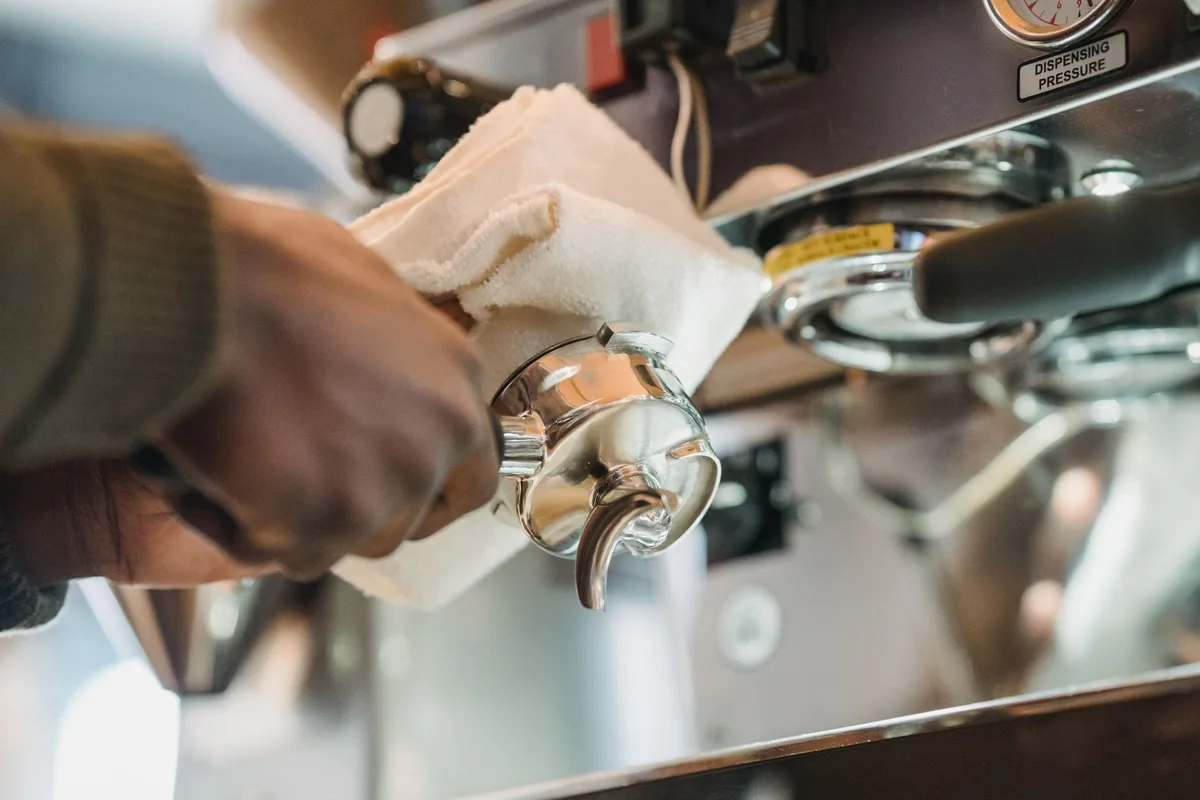
Image source: Pexels / Mizuno K (Pexels License)
There’s a quiet tragedy playing out in kitchens everywhere. Beautiful espresso machines pulling shot after shot, day after day, while coffee oils and mineral deposits slowly build up inside. The crema starts looking dull.
The shots run faster than they should. That rich chocolatey flavor turns bitter and flat.
Most people blame the beans. But it’s rarely the beans. It’s the machine.
Coffee contains oils that don’t just disappear after brewing. Over time, those oils oxidize and turn rancid inside your group head. You’re literally tasting yesterday’s stale coffee in today’s fresh shot.
That’s where espresso cleaning tablets come in, and honestly, they’re the difference between a machine that lasts a decade and one that dies at year three.
With over a decade of experience working on commercial and home espresso equipment, I’m going to walk you through exactly how to use these tablets properly. No guesswork. No manufacturer jargon.
Just the nuts and bolts of keeping your machine tasting brand new.
What Are Espresso Cleaning Tablets?
Before we get into the how, let’s nail down the what. Espresso cleaning tablets are precisely dosed, compressed cleaning agents designed to remove coffee oils, residue, and mineral buildup from your espresso machine’s internal components.
Brands like Cafiza, Puly Caff, and Urnex manufacture these little powerhouses. The active ingredients typically include:
- Sodium carbonate, an effective degreaser
- Sodium percarbonate, releases oxygen to break down organic residue
- Surfactants, help lift and suspend oils so water can flush them away
These tablets aren’t magic. They’re chemistry. And they’re specifically formulated for coffee equipment because coffee oils are stubborn.
Dish soap won’t touch them. Vinegar can actually damage your machine’s seals and gaskets. The tablets are designed to be tough on residue but safe on your equipment.
The beauty of tablets over loose powder? Consistency. Each tablet has the exact right amount of cleaner, so you never have to measure.
You just drop one in and let the machine do the work.
Why You Actually Need to Clean Your Espresso Machine
Here’s what most owners don’t realize. You’re not just cleaning the visible parts. The group head, shower screen, and internal pipes of your espresso machine are where bacteria and old coffee oils settle.
Think about it. Every shot pulls hot water through those components. The water picks up flavor along the way, good flavor if the machine is clean, stale and bitter flavor if it’s not.
The evidence that your machine needs cleaning isn’t subtle:
Your shots are running too fast. A clean machine creates proper backpressure. Dirty internals cause channeling and thin, watery espresso.
The crema disappears quickly. Fresh, properly extracted crema holds its shape. If it vanishes within seconds, you’ve got residue affecting extraction.
You taste bitterness or rancid notes. That old coffee oil taste is unmistakable once you know what to look for.
Visible buildup on the shower screen. If you pop the screen off and see brown gunk, you’re way overdue.
The general rule? Clean once a week if you’re pulling 2-3 shots daily. Commercial environments often clean daily.
Home users who only make weekend lattes can stretch it to every two weeks.
How the Cleaning Tablets Work

Image source: Pexels / Afta Putta Gunawan (Pexels License)
Let’s talk about the cleaning mechanism itself, because understanding it makes you better at using it.
Espresso machines rely on something called a backflush cycle. That’s where you create a “blind” seal at the group head, typically using a purpose-built blind filter basket that has no holes, which forces water back through the system under pressure.
Here’s what happens step by step:
- The cleaning tablet dissolves in hot water
- That cleaning solution gets pushed up into the group head
- Because the blind filter blocks the exit, pressure builds
- The solution gets forced through internal valves and pipes
- Agitation from the pump loosens oils and scale from surfaces
- When you release the pressure, dirty water flushes out
This cycle disrupts and dissolves the biofilm of old coffee oils. It cleans parts you physically can’t reach, the solenoid valves, the brewing chamber, the dispersion block.
Backflushing with plain water does almost nothing. The oils cling to metal and polymer surfaces. Hot water alone won’t break their grip.
You need the chemical action of the tablet paired with the physical agitation of the backflush.
Important distinction: Cleaning tablets are NOT descalers. They remove coffee oils and residue. Descalers (usually a different product) remove mineral scale from hard water.
You need both, but never at the same time. Check if your machine manufacturer specifies which process first. Most recommend descaling less frequently than cleaning.
Step-by-Step: How to Use Espresso Cleaning Tablets
Alright, let’s get into the real meat. Here’s my field-tested method that works across most semiautomatic and automatic espresso machines.
What You’ll Need
- One espresso cleaning tablet (typically 2-3 grams)
- A blind filter basket (sometimes called a cleaning basket)
- Fresh water for your reservoir or line
- A rag or towel for cleanup
- An empty cup or container to catch rinse water
Step 1: Start With a Clean Portafilter
Remove the portafilter from the group head. Take out the regular filter basket. Pop the shower screen off if you’re comfortable doing that, though for regular maintenance, you can leave it in place.
Give the portafilter and basket a quick rinse under running water. You want to start from a “clean-ish” baseline, so you’re not washing loose grinds into your machine.
Step 2: Insert the Cleaning Tablet
Place one tablet directly into the blind filter basket. The basket should sit flat on your counter. Drop the tablet right into the center of the basket.
If your machine’s group head is especially deep, you might need to check the tablet sits comfortably without falling out when you lock in the portafilter. Some machines like the Rancilio Silvia have a shallow group, the tablet can pop out when you angle the portafilter up. If that happens, hold it in place with a finger as you lock it in.
Step 3: Lock the Portafilter Into Place
Twist the portafilter into the group head just like you would for brewing. Make sure it seats snugly. A loose seal means less pressure and a less effective clean.
Do NOT leave it locked in while the machine sits idle. The cleaning solution can soak into rubber seals and degrade them. Only leave it locked during the actual cycle.
Step 4: Run the Cleaning Cycle
Here’s where machines differ slightly. Check your manufacturer’s recommendations. Most machines use one of three approaches:
Standard Backflush (most E61 and semi-auto machines):
- Start a brew cycle for about 10 seconds
- Stop the brew cycle
- Wait 10 seconds for the solution to soak
- Repeat 5-10 times
Alternating On-Off Method:
- Run water for 5 seconds
- Stop for 5 seconds
- Repeat for about 2 minutes
Continuous Flush:
- If your machine lacks a programmable timer, you may need to hold the brew button to run water continuously for 30-60 seconds, then release, wait, and repeat
The goal is to build pressure, release it, let the solution soak, and repeat. Each cycle crushes and releases the cleaning action against built-up gunk.
Step 5: Soak Time Is Critical
After several backflush pulses, let the cleaning solution sit in the group head for 3-5 minutes. This gives the chemistry time to work on stubborn deposits.
Don’t rush this. The soaking is where the tablet truly earns its keep. The mechanical agitation dislodges loose material; the soak dissolves what’s clinging tight.
Step 6: Remove and Rinse
Unlock the portafilter. The water inside should look dirty, sometimes grayish or brownish with visible floating particles.
Empty the blind basket into your sink. Rinse both the basket and portafilter thoroughly with hot water. Don’t use soap.
Residual soap is nearly impossible to fully rinse from coffee equipment.
Step 7: Flush the Machine
This step is non-negotiable. Run a full brew cycle without anything in the portafilter (or with the regular, empty basket in place). Let hot water run through for 20-30 seconds.
Discard that water.
Repeat this flush 2-3 times. You’re clearing any residual cleaning solution from the internal lines.
Step 8: The Taste Test
Pull a shot with fresh coffee but don’t drink it yet. Smell it. Taste a sip.
If you get any hint of soap, chemical, or “cleaner” flavor, flush the machine again.
You should taste pure, clean coffee, no off-notes.
Rinsing After Cleaning
Image source: Pexels / Pixabay (Pexels License)
Let me emphasize that rinsing step because it’s the difference between brilliant coffee and accidental soap shots.
Espresso machines have internal plumbing. Water travels along paths you can’t see. Those paths hold cleaning solution after a backflush.
If you skip the rinse cycle, you’re pulling your next shot through cleaning chemicals.
We had a customer who insisted his espresso tasted “metallic.” His cleaning routine was on point, but he never ran clean water through after the cleaning tablets. A few residual traces of cleaning solution were tinting every shot. Two rinse cycles later, the problem vanished.
Here’s my rinse protocol:
Minimum: 2 full boiler cycles of water flushed through the group head.
Better: Remove the shower screen and soak it in hot water after cleaning. Wipe the group head gasket clean.
Best: Pull a blank shot (no coffee) into your sink, let the machine fully heat, pull another blank shot, then pull an actual shot you’ll drink.
If you have a machine with a three-way solenoid valve (most quality machines have one), the rinsing also clears the valve of any cleaner residue. This is important because that valve connects to the drip tray and can hold residue.
How Often Should You Clean?
There’s no universal answer, but let me give you practical guidelines based on usage:
Heavy home use (3+ shots daily): Clean every 7 days
Average home use (1-2 shots daily): Clean every 10-14 days
Weekend-only use: Clean every 3-4 weeks
Commercial or office use: Daily after closing
Rental properties or Airbnbs: Before every new guest, you have no idea what previous users did
Here’s a quick reference table:
| Usage Level | Cleaning Frequency | Descaling Frequency |
|---|---|---|
| Daily heavy | Weekly | Monthly |
| Daily light | Bi-weekly | Every 6-8 weeks |
| Occasional | Monthly | Every 3-4 months |
| Commercial | Daily | Weekly |
This routine has served me well across dozens of machines. If you’re pulling shots that taste great and you see no visible buildup, you’re on track. If flavor shifts, clean more frequently.
Common Mistakes to Avoid
I’ve seen plenty of well-intentioned owners screw this up. Here’s what to avoid:
Using the wrong tablet size. Espresso tablets are 2-3 grams. Descaling tablets are different products. Don’t substitute.
Also, some tablets are designed for dishwasher-style cleaners, those are not for espresso machines.
Running the cleaning cycle for too long. A 10-15 minute soak on the group head can damage rubber seals and gaskets. Five minutes is plenty.
Skipping the blind basket. Some folks try to backflush with a normal basket. That way you push cleaning solution out through the spouts into your cup, not back through the system. That’s just a rinse, not a clean.
Forgetting to flush afterward. You’ve already read the story above. Don’t be that person.
Mixing cleaners. Never use a descaler and a detergent-based cleaner in the same cycle. Some machines actually warn against alternating them without a thorough rinse first.
Backflushing machines that can’t handle it. Some consumer machines with thermoblock heating systems or vibratory pumps might not be designed for chemical backflushing. See our note below.
Do All Espresso Machines Support Chemical Cleaning?
This matters. Not every machine can handle a chemical backflush.
Espresso machines designed to backflush have either a three-way solenoid valve or a mechanical E61 group that opens a release valve when you stop the pump. These machines are built to handle the pressure consequences of a blocked flow path.
Machines that support chemical backflushing safely:
- E61 group machines (Prosumer and commercial style)
- Most machines with solenoid valves (Rancilio Silvia, Gaggia Classic Pro, Breville/Sage Dual Boiler)
- Commercial machines (La Marzocco, Synesso, Rocket, etc.)
Machines where chemical backflushing is questionable:
- Simple thermoblock machines like the Delonghi Dedica
- Pressurized basket-only machines with no solenoid valve
- Some older steam-driven machines
For those simpler machines, you can still clean the group head, but you’ll need to do a different wash. Put the cleaning tablet in a bowl of hot water, stir to dissolve, and then run the machine’s group head flush through that solution using a siphon or by drawing water through the system. This is less effective but safer for the equipment.
If you’re unsure, check your owner’s manual for the manufacturer’s stance on backflushing and chemical cleaning tablets. Within the US, works with U.S. National Sanitation Foundation standards guidelines for food equipment cleaning products, that NSF certification is a good indicator your cleaner is approved for food contact surfaces.
How to Store Cleaning Tablets
These tablets are chemically active. They respond to humidity and heat. Store them in a sealed container, away from direct sunlight.
The ideal storage spot is a cool, dry cabinet, not next to your stovetop or dishwasher. Many brands ship in foil-packs or sealed jars specifically to protect the tablets from moisture.
Expired tablets lose potency but won’t necessarily hurt your machine. That said, the longer they sit, the less effective they become. Buy a container you’ll finish in 6 months.
It’s not worth hoarding cleaning supplies.
The Difference Between Cleaning Tablets and Descaling Tablets
People conflate these constantly, so let’s make it crystal clear.
| Cleaning Tablets | Descaling Tablets |
|---|---|
| Remove coffee oils | Remove mineral scale |
| Detergent-based | Acid-based (citric or sulfamic) |
| Use weekly | Use monthly or quarterly |
| Requires backflush | Requires reservoir treatment |
| Safe on gaskets | Can degrade some rubber |
Cleaning tablets combat the build-up of coffee oils from extraction.
Descaling tablets dissolve limescale and mineral deposits from water.
Both are needed for a truly healthy machine. Many modern machines in hard-water areas need descaling every 1-3 months, even while cleaning weekly. Never run both at the same time.
The chemical reaction between a strong acid and a degreaser can create corrosive compounds.
Final Thoughts on Cleaning Your Espresso Machine
Maintaining an espresso machine isn’t glamorous. But it’s the single most impactful thing you can do for your coffee’s flavor and your machine’s longevity.
The window between “I should clean this” and “the shots taste weird” is short. Once that rancid oil taste develops, it takes multiple cleaning cycles to fully remove. Prevention is cheaper and faster than cure.
Grab your tablets. Pop one in the blind basket. Give your machine five minutes of attention.
Your next shot will thank you.
If you’re already using espresso cleaning tablets regularly and your shots still taste off, take a look at your water quality, grind settings, and the machine manufacturer’s recommendations for descaling. Sometimes cleaning isn’t the whole story. But if you’re not cleaning, that’s almost certainly where the problem starts.
A clean machine makes clean espresso, and clean espresso is the difference between coffee you drink and coffee you love.